Just a quick intro on the Cool-Lux Lux Gears. These can be added over the focus ring if you're working with non-cine lenses and have to use a follow focus system. It's a flexible material that is still firm enough to where it won't slip under your FF. They make a variety of sizes so that they can fit perfectly with your lens.
They have a basic Lens Compatibility Chart showing which Lux Gear should work with most popular lenses. But if you can't find your lens on the chart, you can also print out a ruler (on their website) that will let you measure your lens and select a proper size. You can check out the Cool-Lux Lux Gears following the link (here).
When i'm in a bind and need an ND filter to fit over my wide angle lenses, here's a little tip on how I make a custom Wide Angle filter adapter. Most people will just tape an ND directly to a lens, but this method allows you to put one on and take it off just as quick. It a simple process that works with basic card stock formed into a cylinder and cut to size. [The firmer the card stock the better..]
Now what you want to make sure you do before starting this project is test the filter that you plan on using. These wide angle lenses must use oversized filters, and for my Panasonic 7-14mm i'm using an 86mm Variable ND. If you have to go bigger than this, Fotodiox makes ND Filter sizes up 145mm (found here).
Normally we've gone as far as 3D Printed adapters, but when you're pressed for time this works all the same. This trick works on just about any wide angle or fisheye lens so long as you have an oversized filter. You can use this method to hold circular or square filteres. It will also work on many Cinema Prime lenses that don't have front threads.
If you really want to get creative, you can make one of these attached to a step up filter ring (instead of directly to a filter). Now that you have a filter ring, you can swap the front filter with different types (polarizers, different density static NDs, gradients, etc).
Sorry again for the weird audio, shot this with an iphone in hand as one of those spontaneous things. Hope the tip helps, leave some comments.
Although this CAME-OPTIMUS Gimbal i'm working with is an early prototype, it's been a solid workhorse. I've been putting it to the test on several Real Estate listings shooting up to 6 hours a day on a single battery.
I'm using the CAME-OPTIMUS Gimbal mainly with the GH4 or Sony A7s and have not had any issues so far. For small mirror-less cameras like the GH4 or Sony A7sII with native lenses, I'm guessing this could turn out to be a very popular item.
A prototype extension adapter that sits between the DJI OSMO and it's handle. This way you can still hold the gimbal comfortably and operate the joystick for Pan and Tilt.
Everyone eventually needs external hard drive space. For most people it might just be basic storage. But if you're a Photo / Video editor you might be interested in fast performance. Or perhaps you're concerned about protecting data from an important project and you want to have a backup mirrored drive (redundancy).
Here's a sub $100 dollar Dual Hard Drive Dock that can do all of those things, while still remaining flexible depending on your needs. With built in hardware, it's incredibly easy to setup. All you need to do is insert blank drives, flick a few dip switches, and press button to initiate your Drive Setup choice.
The Xcellon allows you to dock either larger Desktop 3.5" or smaller 2.5" drives. It even works well with Sandisk Solid State Drives (SSD). And the Dock makes it easy to swap like an old video game cartridge if you happen to store data across multiple drives.
The benefit to these drive docks is you'll end up saving money by just buying bare drives with no enclosures. When your drives are not in use, you can store and protect them in dedicated Hard Drive cases (like these).
If you're even more organized, you can create several different types of external storage and swap between them depending on your needs at the current time.
Using JBOD, the dual drive dock is your basic external hard drive. For each hard drive, you'll see a different Storage Drive on your computer.
Using Span is basic storage but takes both drives and only shows you one single external drive on your system. So that you don't have to think about which drive your footage is store in.
If you're looking for fast performance from your drives while editing videos / photos, then you might want to setup two Drives in a Raid0. This will allow your system to send data between both drives simultaneously. But keep in mind there is no redundancy here.
If you're more concerned about redundancy (mirrored data), then you'll want to choose a Raid1 setup. The data written to one drive is automatically duplicated to the other in case of a hard drive failure. A great way to ensure your important client data is safe.
Not quite as fast as Thunderbolt, but the Xcellon Dual Hard Drive Dock is setup to take advantage of increased capable speeds with the latest Type-C USB 3.1 (and backwards compatible).
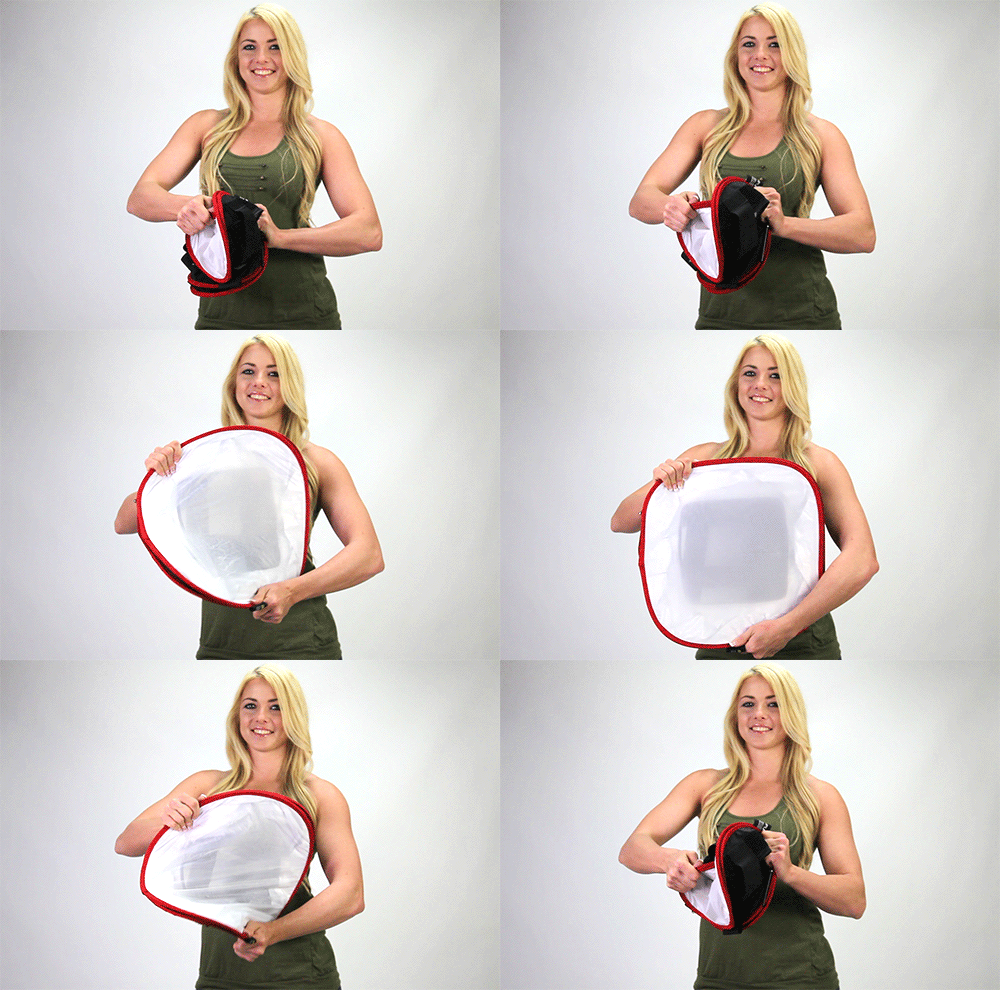
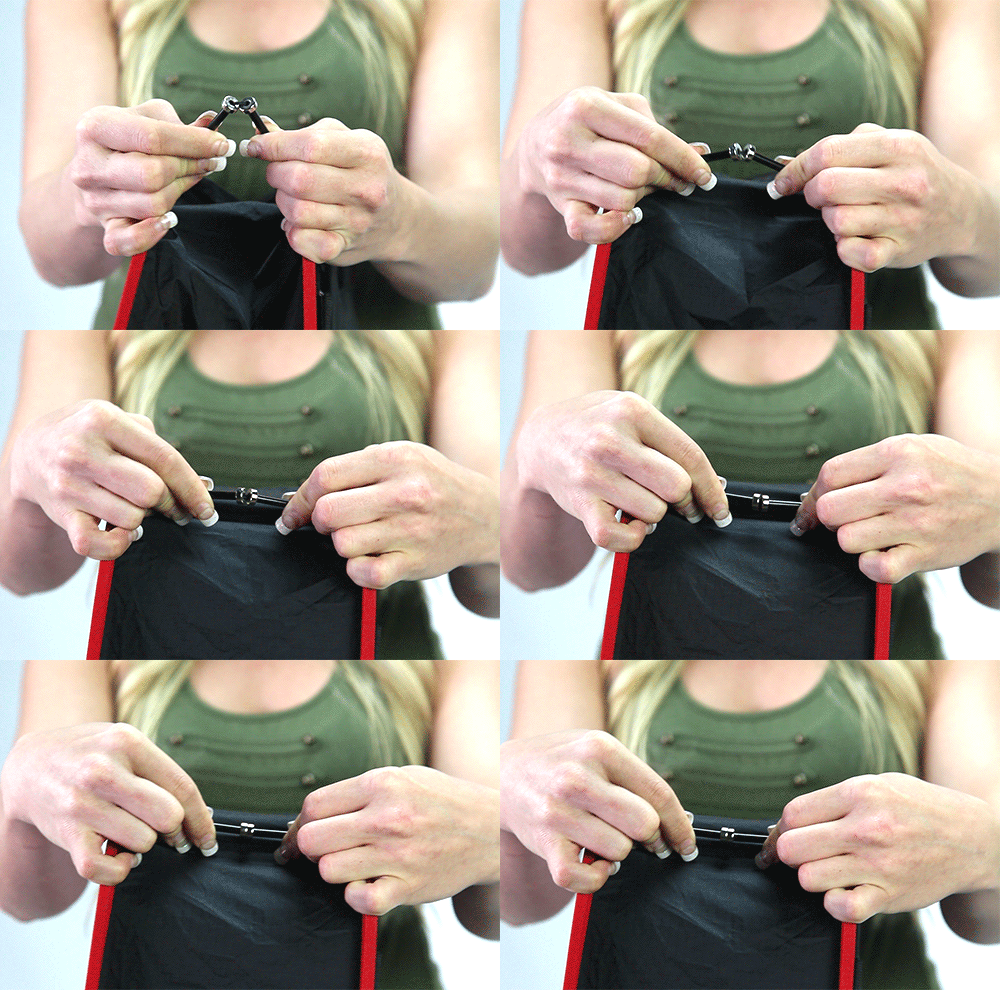
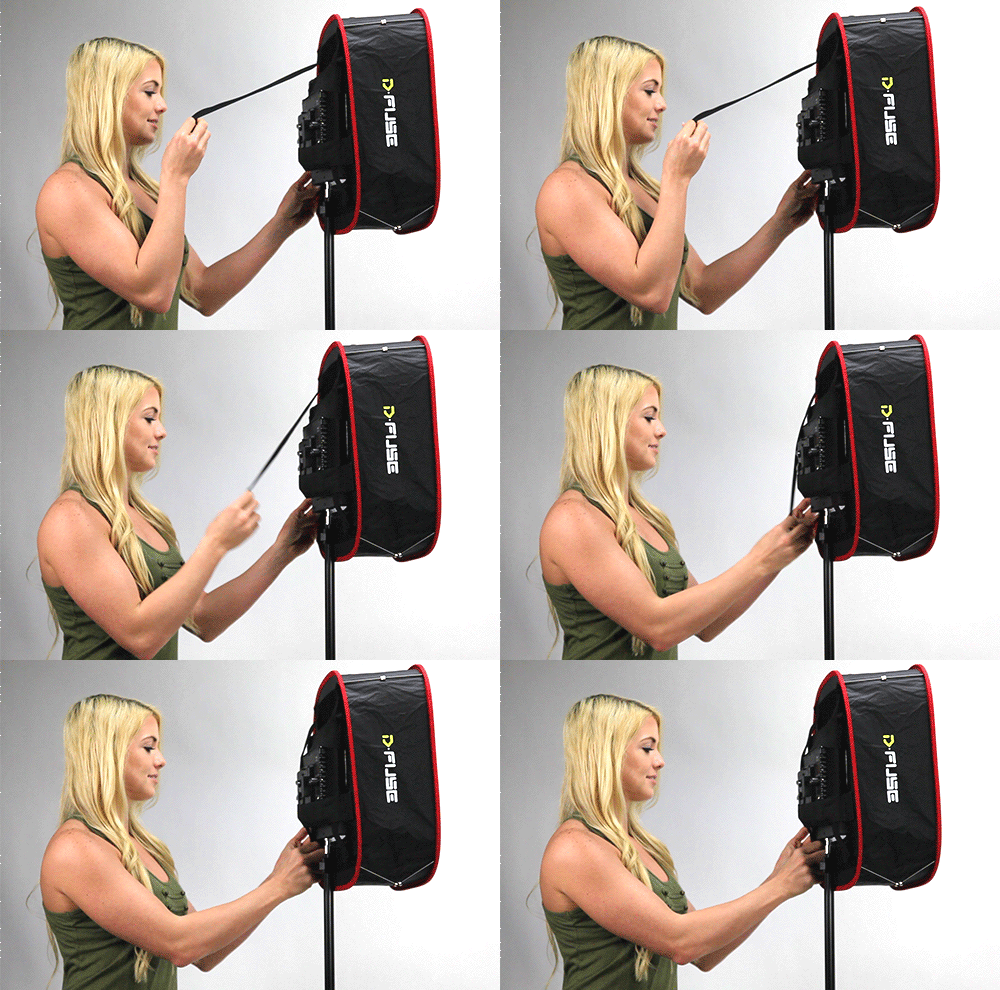
When you're looking for effective light diffusion while keeping things simple and fast check out the new D-Fuse Instant Pop Up Softbox for LED light panels. Like many softbox kits, the D-Fuse uses rods to create a structure and hold the diffusing material a distance away from the source. Using a unique (patent pending) design, the length of the rods found at each corner setup and break apart through strong Magnets, and the rods remain as part of the Softbox when folded up. No no loose parts to lose or misplace!
I highly suggest diffusers like this for anyone using LED Light Panels during interviews that are facing directly towards your subject. Bare LED Bulbs are pretty hard on the eyes, and the last thing you want is your subject squinting or ending up with a headache. You'll immediately see a difference in how soft the shadows are which is also more flattering for many subjects.
The current D-Fuse Pop Up Softbox for LED Light Panels is designed for popular 1x1 LED Panels, but they will be releasing additional sizes and adapters to fit other popular sized LED Panels as well. But seeing how it's mostly a Velcro fit, i'm sure this current version can easily be modified to use with just about anything if you can't wait for the other sizes to become available.
Updating a tried-and-true optical design for use with full-frame E-mount mirrorless cameras, the Batis 85mm f/1.8 Lens from Zeiss is a portrait-length, short telephoto lens featuring a fast f/1.8 maximum aperture for greater focus control and enhanced low-light shooting. The innovative design of this lens features an OLED display that highlights the focus distance and depth of field range for quickly recognizing your focusing parameters, and its autofocus performance is benefitted by linear motors for fast, smooth performance. Pairing the Sonnar concept with a floating elements design, this 85mm f/1.8 is also particularly adept at controlling aberrations throughout the focusing range, while a T* anti-reflective coating minimizes flare and ghosting for ensured color accuracy and heightened contrast. Rounding out the feature-set, this lens incorporates optical image stabilization to minimize the appearance of camera shake when working with slower shutter speeds and a dust- and weather-sealed construction lends itself to shooting in less-than-ideal environments.
Zeiss Batis 85mm f/1.8 Lens for Sony E Mount B&H # ZE8518B
Pairing the tested Distagon concept with contemporary functionality, the Batis 25mm f/2 Lens from Zeiss is a wide-angle prime designed specifically for full-frame E-mount mirrorless cameras. The innovative design of this lens features an OLED display that highlights the focus distance and depth of field range for quickly recognizing your focusing parameters, and its autofocus performance is benefitted by linear motors for fast, smooth performance. Four double-sided aspherical elements within a floating elements design help to control aberrations and distortions throughout the focusing range and contribute to even edge-to-edge sharpness and illumination, and a T* anti-reflective coating reduces flare and ghosting for increased contrast and color neutrality. Ideal for architecture, landscape, and interior photography, this lens' 82° angle of view pairs with a 7.9" minimum focusing distance for producing creative perspectives and unique close-up imagery. Additionally, for working in inclement conditions, the lens also features a dust- and weather-sealed construction.
Zeiss Batis 25mm f/2 Lens for Sony E Mount B&H # ZE2520BFE
Pairing a versatile range of telephoto focal lengths with a fast constant maximum aperture, this 50-100mm f/1.8 DC HSM Art Lens from Sigma is designed for APS-C-format Canon EF-mount DSLRs, and provides an 80-160mm equivalent focal length range. The bright constant maximum aperture offers consistent low-light performance throughout the zoom range and also affords greater control over focus placement for shallow depth of field and selective focus applications. Complementing the versatile telephoto range is a sophisticated optical design that incorporates three F Low Dispersion elements, one Special Low Dispersion element, and one high-refractive index, high-dispersion glass element. This combination of low dispersion designs works to noticeably reduce chromatic aberrations and color fringing throughout the zoom range, as well as deliver a high degree of contrast and clarity. Additionally, a Super Multi-Layer Coating has been applied to lens elements to reduce lens flare and ghosting to benefit working in strong lighting conditions. An unprecedented combination of focal length and speed, this 50-100mm f/1.8 lens offers a variety of favored telephoto perspectives in combination with a flexible maximum aperture.
1920 x 1080 Touchscreen LCD
Records UHD 4K/HD Up to 30 fps
10-Bit, 4:2:2 ProRes or DNxHD
HDMI and 6G-SDI Video Inputs
Dual SD Media Card Slots Supports UHS-II
Two Mini XLR Inputs with Phantom Power
On-Screen Histogram and Audio Levels
Focus Peaking & Zebra
Dual LP-E6 Hot-Swappable Battery Slots
AC Adapter Included
I know a lot of people were waiting for this, and it's finally here - the official DJI OSMO X5 Adapter to (properly) mount that Mirrorless X5 Interchangeable Lens camera.
This is pretty big news for those looking for the smallest combination of ILC and 3-Axis Gimbal. But with a bigger camera this means shorter battery life. So DJI has also announced an OSMO external battery extender. The battery extender allows for a DC input, or you can get an optional cable to connect directly with one of your DJI Drone batteries.
DJI has certainly thought of just about everything, but the X5 camera isn't cheap (unless you already have an Inpsire1 Pro). The X5 is a micro four-thirds camera and starts at $1699 (here).
And just in case you're not familiar with the DJI OSMO, here's an introductory video showing the basic version with the entry level X3 camera.
Of course you can improve the OSMO system greatly by adding some of the new accessories and camera mentioned in this article. DJI OSMO for X3 X5 X5R Camera Gimbals


 Lux Gears - Cool-Lux Seamless Follow Focus Lens Gears

 3.5" / 2.5" Hard Drive Storage Protection Cases


 BlackMagic Design Video Assist 4K Video Monitor Recorder


 DJI OSMO for X3 X5 X5R Camera Gimbals